
Waiting

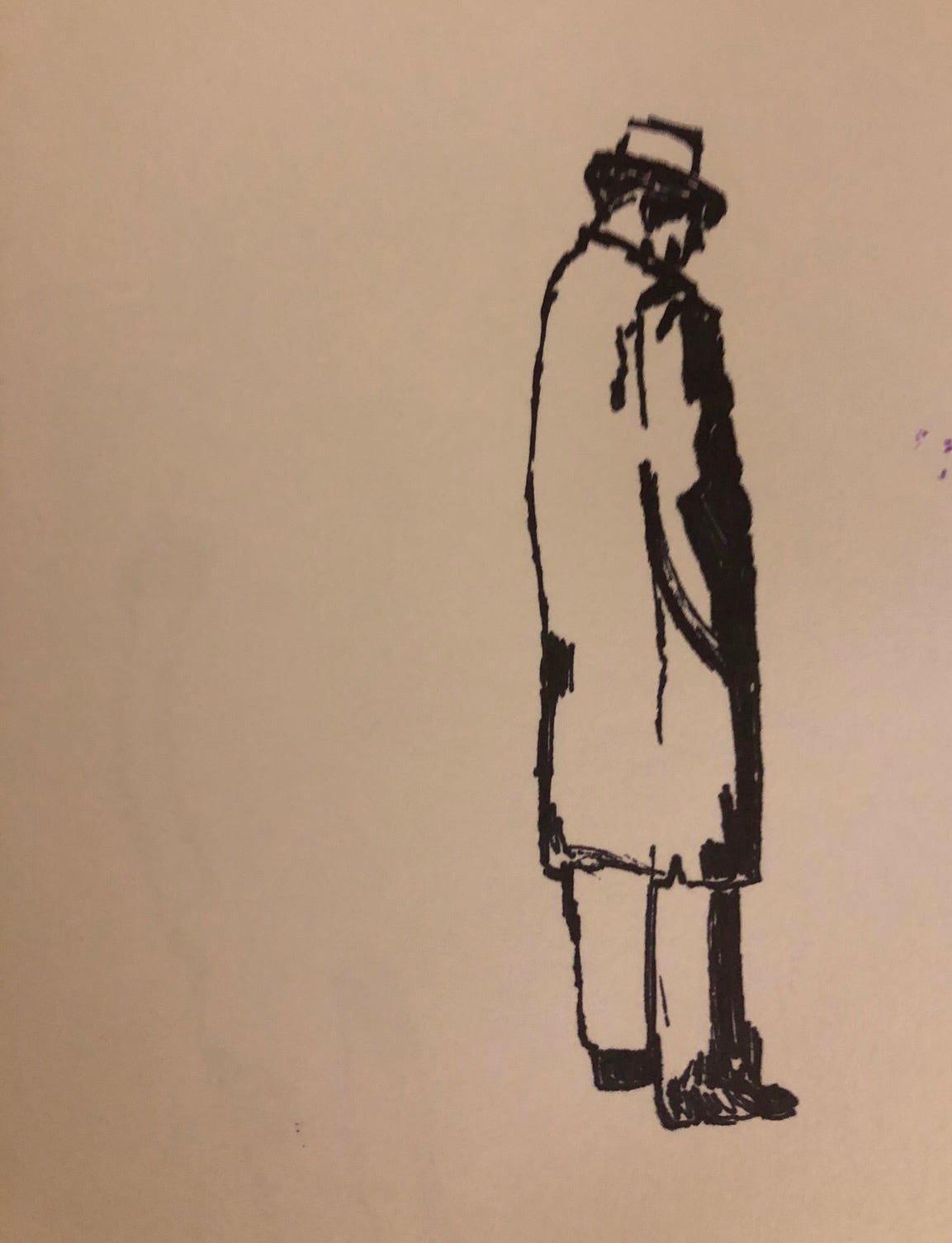
1.
Once I was in a play and part of our rehearsal period involved studying clowning. Every day we met with a Master from Mexico. His name was Sigfrido. He didn’t speak much English but he tried to find the right words to explain how to be funny: It’s like this (and he put his hands together) and then like that (apart). And then to clarify, he said, Everything and nothing… Okay? It was one of those explanations that made so little sense that we had to accept it completely.
For our first exercise, he told us to get up on stage, one by one, and be funny.
What should we do? we asked.
Funny, he said.
The only rule was: no words. If you didn’t make us laugh, you got the thumb, the raspberry, the gong. So one by one we went up onstage. We wiggled and shrugged, made faces, danced jigs, pretended to laugh, cry, rage, (silently) we tripped and fell, farted, sneezed and each time, within about 10 seconds, Next! We all failed. Still, we tried the exercise again and again and again. Every day we got a little better at it. Eventually we stopped trying. We stood still. We yawned. We craned our necks to look up at the ceiling looking for cracks. We noticed something strange up there. What is that? We crossed our arms and looked out at the audience. What? And somehow, finally, we were funny. It turns out just standing there, waiting, is the most honest thing you can do. And usually that’s the funniest.
If you think about what makes you laugh, it usually involves a surprise of some sort. But it’s more than that. It involves surprise and relief at the same time. Just like death. I’ve been thinking about this, about humor and dying and waiting and the similarities between birth and death, the way there are specific stages in each, the way babies and old people (elders? seniors?) are so alike, and I’m not sure if I can put my finger on it, on what is similar, how, and what it means, but if you asked me I would say it’s everything and then it’s nothing.
2.
We are in waiting mode and it’s giving me agita. I wait. I tune out. I lose things. I forget where I put my phone, my glasses, my keys. I leave the car running. That goddam silent, press on-switch car! Mo tells me when I dissociate, the inside of my head is like a shoe in a dryer.
“You can tell that from just looking at me?” I ask.
“Yep,” she says.
Oh, I laughed. I laughed with such joy. To be seen! What a relief. I woke up in the middle of the night and laughed again alone in the dark thinking about it. Thank god for my kids.
Yesterday Harry told me he worked in the kitchen for the first night at his job. He was not on the line but they asked him to make a sauce, sort of like a bechamel, but with cognac. He made it with care like always, and then said they told him it was perfect. I love how proud he feels. When I told my sister about it. She said you don’t want him to turn into an alcoholic like every chef who works in a kitchen. Not her exact words but that’s what I heard. On the one hand, no, I don’t. On the other hand, well that does happen. On the other hand, isn’t it a strange thing to say rather than be excited and hopeful? On the other hand, she is not wrong. On the other hand, that is the way she sees everything. And that’s fine. I mean not easy for herself, but that’s her thing. She looks for the doom and then prepares to battle it and conquer it. And the thing is, she does battle and conquer it. Successfully and precisely and in a timely fashion. And then here’s me, a shoe in a dryer, clung-clunk, clung-clunk, clung-clunk.
3. I don’t want to write again about the hospice situation but what else is there? My mom does not use the word dying, instead she has taken to saying things like “I don’t know when the lord will take me.” It’s not her language, but that’s what she says. All of a sudden, with the topic of death, she is Ma Joad in bed waiting…. I don’t know when the good lord will take me also sounds like a bluegrass song, corn in the cornfields, twangy voices, banjo picking. I read recently that you die the way you live. That sounds right. My mom is very theatrical. She performed in plays and taught acting, and on top of that she is Italian, so she has a flair for drama: the loud gasp, a sudden cry, eyes wide with hands covering the mouth. She laughs easily too. When I was in a theater company, the cast would ask, Is your mom coming tonight? She would always laugh the loudest, and it was contagious.
These days she’s in bed saying, I don’t know when the Lord will take me! Maybe tomorrow she will say Nigh the dark winds blow and the hand of father time is reaching ever closer, or maybe And now the end is near, and so I face the final curtain. Or maybe Sorry Jimmy, hate to be a killjoy, it’s coitins fa ya, BANG.... She said it again last night, “Deird, I don’t know when the lord is going to take me.” I never know what to say, but then I remember something that Kate the hospice nurse had said “She’ll go when she decides she’s ready to go”, so I tell her that.
“You’ll go when you’re ready.” I tell her.
“Oh yeah, that’s right,” she says. “That’s it.”
Limbo. “The Waiting Place” (Dr Seuss). I love the three parts here, as always - brilliantly written.
My Mum lost the capacity for meaningful communication, which was SO SO hard.
I don’t do religion but I was effectively praying for her parents (long gone) to come and get her. It was torture.
I think she waited until my cousin came over from England and I had someone with me. On the second visit with my cousin, I felt my Mum skip out the door as we walked in to her room. My cousin is a nurse and we looked at Mum and decided between us that she had gone. I had to go tell the nurse in charge that my Mum wasn’t alive any more. You should have seen that nurse jump off her chair!
Dierdre, I just love your writing. I would love to see you!